TRACKLIST
A1 Afro'dadian
A2 Bringin' Off
A3 Dat Is Horrors
A4 Kaiso For Mouth Band
A5 Song For Music
A6 Make Life Easy On Me
B1 Yo Tink It Sorf
B2 Carnival Drum Song
B3 Doh Dig No Blues
B4 Umbawa
B5 Do You Know Where You Are Going To
B6 In A Man’s Life
C1 Chant
C2 Get Off The Radio
C3 Dance Jambalasie Dance
D1 Free South Africa
D2 Kamboulay (Dance Mix)
E Blow ’Way
F Funky Calypso
ABOUT
The origin of Rapso – a revolutionary voice from Trinidad is finally reissued.
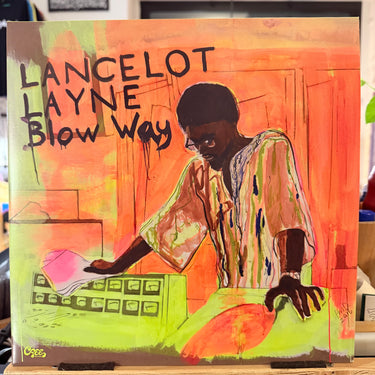
Lancelot Layne is hailed as the father of Rapso – a powerful fusion of calypso, soca, funk, and poetic protest. Blow ’Way (1971) was the first of its kind – and now returns in a deluxe 2-LP set plus bonus 7" single.
Pressed on 180g vinyl and housed in a beautiful gatefold sleeve with a 20-page booklet featuring liner notes by Niasha Layne-Forde and Christopher Laird. The artwork is by world-renowned painter Peter Doig, who resides in Trinidad.
Tracks like Afro’Dadian, Bringing' Off, Strike Squad and Kamboulay deliver radical Caribbean expression rooted in rhythm and resistance.
A powerful reissue from one of the Caribbean’s greatest musical voices – essential and uncompromising.
In 1971, two songs were released in Trinidad & Tobago that represented completely new directions in the musical and lyrical expression of our place in the diaspora, Indian on one hand and African on the other. Nanny & Nana by Sundar Popo and Blow 'Way by Lancelot Layne were revolutionary and groundbreaking and spawned two distinctly new genres in the music out of Trinidad & Tobago — Chutney music in the case of Sundar Popo and Rapso, and in Lance's case.
The A and B sides of this release, Blow' Way and Afrodadian, together express the main themes which were to inform all of Lance's subsequent work and activism - resisting foreign cultural influences which operate at the expense of one's own traditions: Don't believe that what foreigners do is better than you Because that ain't true.
And reconciling one's racial origins -Africa — and national status — Trinidad/Caribbean/Diaspora.
This Country is diverse in its colours and races. People coming from different backgrounds, different places. In reality, this may be the challenge it faces. During 1971, Lance recorded at least half a dozen startlingly original songs. Each one expanding his talent for musical arrangements and dramatic counterpoint with chorus responses and vocal variation. He enlisted musicians, each exciting and pioneering in their own right, breaking ground in the post 1970 cultural revolution: calypso/jazz pianist, Clive Zanda; composer, guitarist, singer and flautist, Andre Tanker; Mau Mau Drummers, including the young Jah Jah Onilu, Mansa Musa Drummers; vocalists, including Ann Marie Innis and Ella Andall. The result is exciting, confident and musically ground-breaking.
In 1972, Lance went to New York to seek ways to advance his music opportunities, taking with him the master tapes of an album of his work. There, he discovered his tapes were so badly recorded in Trinidad studios that they weren't the stereo recordings he had paid for and weren't worth releasing.
This was a crushing blow. While in New York, he had to support himself by working as a parking attendant in the winter and as a pest exterminator. As a pest exterminator in Harlem, Lance, this fresh, driven, optimistic young man from Trinidad, came face to face with the reality of African American life in urban USA.
On his return home he had horrifying stories of what he had encountered in those Harlem tenements: the slum landlord buildings, the huge rats that attacked unwary children, cleaning apartments, the lone occupants of which had died unnoticed for days and weeks and were densely infested with vermin crawling from floor to ceiling and oozing with what was left of the body of the deceased.